
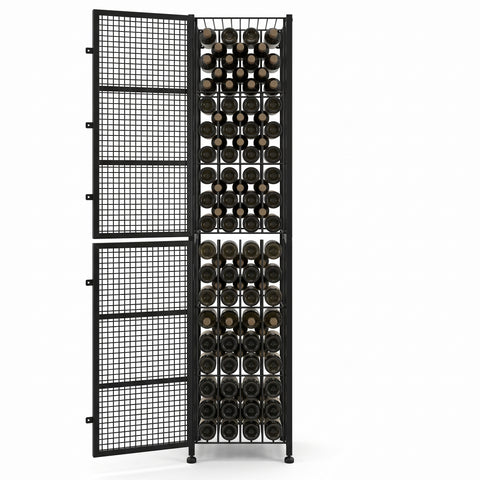
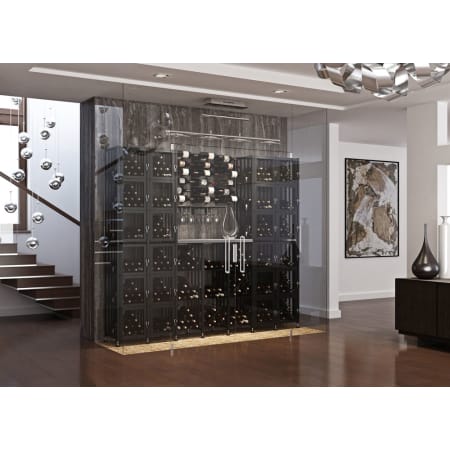
VintageView Case & Crate 96 Bottle Lockable Wine Cabinet
A tall, narrow modular wine locker that stores at least 96 bottles while using very little floor space. Two stackable Case & Crate lockers create secure vertical storage that can be extended further as a collection grows.
Why you’ll love it
- Minimum 96-bottle capacity
- Tall 7-foot vertical configuration
- Two stackable locker modules
- Lockable mesh-front storage
- Expandable modular system
- Durable steel construction
- Freestanding installation
- Limited lifetime warranty
Key specifications
| Bottle capacity | 96 |
|---|---|
| Installation | Freestanding |
| Finish | Black Steel |
| Width | 15.25 in |
| Height | 84.13 in |
| Depth | 14.5 in |
| Shelf material | Steel |
| Warranty | Limited lifetime |
Bottle capacity is based on standard 750ml Bordeaux bottles and may vary with bottle shape and shelf configuration.
FAQ
Helpful guidance on storage, temperature, installation and everyday use.A single-zone cooler maintains one temperature throughout the cabinet, making it ideal if you mainly store one type of wine. Dual-zone models have two independently controlled temperature areas, allowing you to store red and white wines at different temperatures in the same unit.
For long-term storage, most wines are best kept at around 12°C to 14°C. If you are storing wine ready for serving, white wines are generally kept cooler than reds. Always check the temperature range of the individual model.
Yes. A dual-zone wine cooler is ideal for this because each zone can be set to a different temperature. In a single-zone unit, both can still be stored together at a suitable cellar temperature.
Built-in wine coolers are designed with front ventilation so they can be installed beneath counters or within cabinetry. Freestanding models require more airflow around the sides and rear and should not normally be enclosed unless the manufacturer specifically allows it.
Yes, provided the model is designed for built-in installation and the required ventilation clearances are followed. Many of our under-counter models are specifically designed to integrate neatly into a kitchen.
Bottle capacities are normally based on standard Bordeaux-style 750ml bottles. Larger Burgundy, Champagne or unusually shaped bottles can reduce the total capacity.
Different bottle shapes and shelf arrangements affect how many bottles fit. The published capacity should be treated as a maximum under standard test conditions.
Two-door coolers typically provide more flexible storage, easier access and, on some models, separate temperature zones. They are particularly useful for larger collections or mixed wine storage.
Yes, provided the model maintains a stable temperature and is installed correctly. Purpose-built wine coolers also help protect bottles from excessive temperature fluctuations, light and vibration.
Yes. All refrigeration appliances require ventilation. Built-in models usually ventilate through the front, while freestanding models often require additional clearance around the cabinet. Always follow the manufacturer’s installation instructions.
Wine coolers use compressors and internal fans, so some operating noise is normal. Noise levels vary by model and installation environment. Correct levelling and ventilation can help minimise vibration and sound.
Energy consumption varies by size, cooling system and usage. Smaller units generally consume less energy than large-capacity models, while frequent door opening and high ambient temperatures can increase consumption.
Only if the ambient temperature falls within the operating range specified by the manufacturer. Garages can become too hot or too cold, which may affect performance.
Yes. Champagne and sparkling wine can be stored in a wine cooler, although wider bottles may reduce the stated bottle capacity or require shelf adjustment.
This depends on the model. Many wine coolers feature removable or adjustable shelves, while others use fixed wooden or metal shelving. Check the individual product specification for details.
Horizontal storage helps keep natural corks in contact with the wine, reducing the risk of the cork drying out during longer storage periods.
Many wine coolers use tinted or UV-resistant glass to reduce exposure to harmful light. The exact level of protection varies by model, so check the product specification if UV protection is important to you.
Refrigeration appliances should normally be allowed to stand upright before being switched on, particularly if they were transported on their side. The recommended waiting period varies by manufacturer, so follow the instructions supplied with your unit.
Consider how many bottles you want to store, whether you need one or two temperature zones, whether the unit will be built in or freestanding, the available dimensions, door configuration and your preferred finish. If you expect your collection to grow, choosing a slightly larger capacity can be worthwhile.

